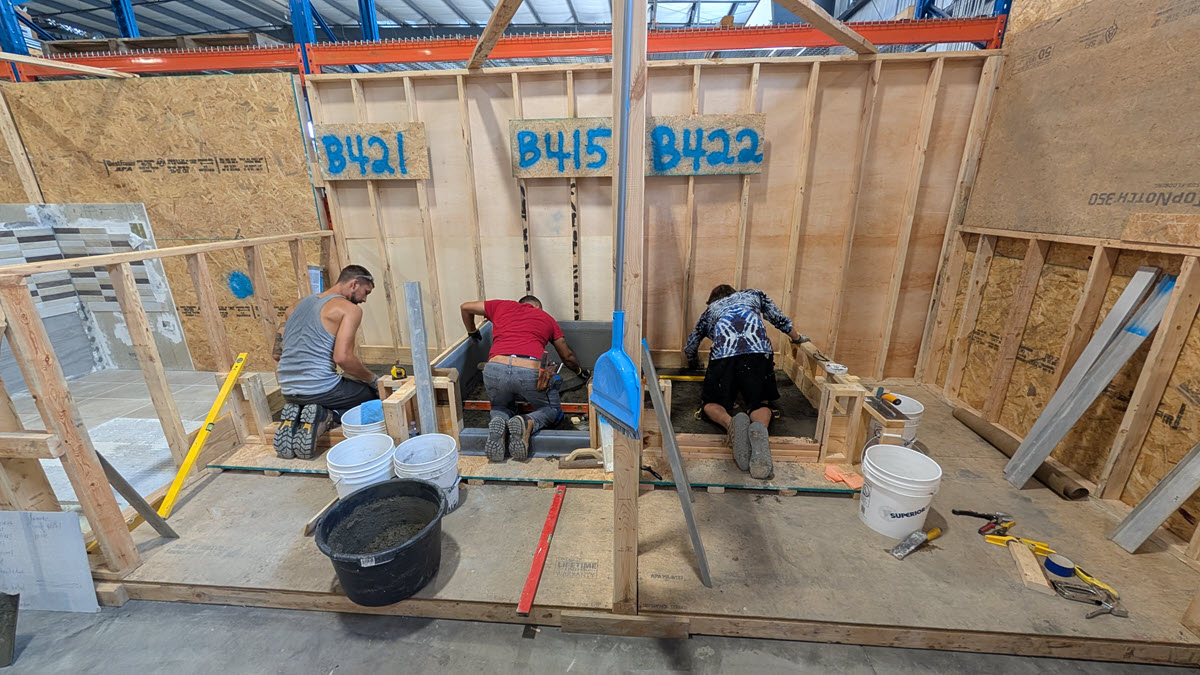
A homeowner asks a seemingly simple question: “I am rebuilding my shower. Should I use a PVC liner again, a sheet membrane, a liquid waterproofing system, a foam pan, or a mud bed?” Ask ten tile installers, and you may get ten different answers.
-
Use a traditional liner.
-
Use a bonding-flange drain.
-
Build the pan with mud.
-
Use a foam tray.
-
Use sheet membrane.
-
Use liquid waterproofing.
-
Use a combination of products that has “worked” for years.
Several of those answers may be perfectly reasonable. The problem is that we have started talking about materials before anyone has identified the method.
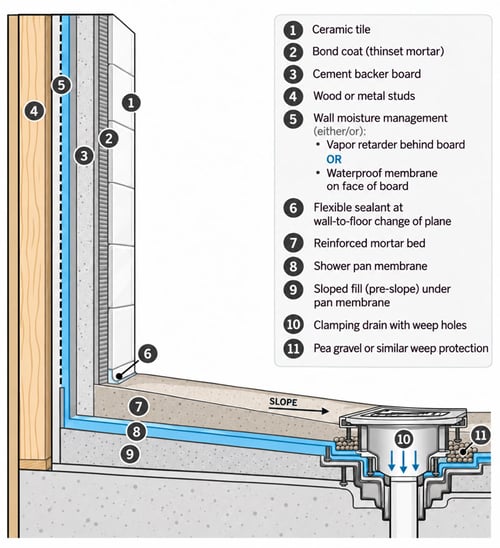
Traditional Shower Drain Assembly Diagram
What Method Applies to Your Shower System?
A shower receptor isn't just a collection of waterproof products. The drain, slope, waterproofing location, receptor construction, wall system, transitions, and setting materials must work together as a complete assembly.
Start with the Tile Council of North America (TCNA) Handbook method.
Then make sure the drain, receptor, waterproofing, and materials all belong to that method.
The drain matters - but the drain can also change
The drain is one of the most important clues to understanding a shower system, and you shouldn't treat it as an immovable starting point. The drain that happens to be installed when the tile contractor arrives does not necessarily have to dictate the final assembly.
If the existing drain does not fit the intended shower method, the installer may be able to:
-
retain the drain and select a compatible method;
-
use a manufacturer-approved adapter or conversion assembly; or
-
have a plumber replace the drain with one designed for the intended waterproofing system.
That decision should happen before the installer starts combining materials.
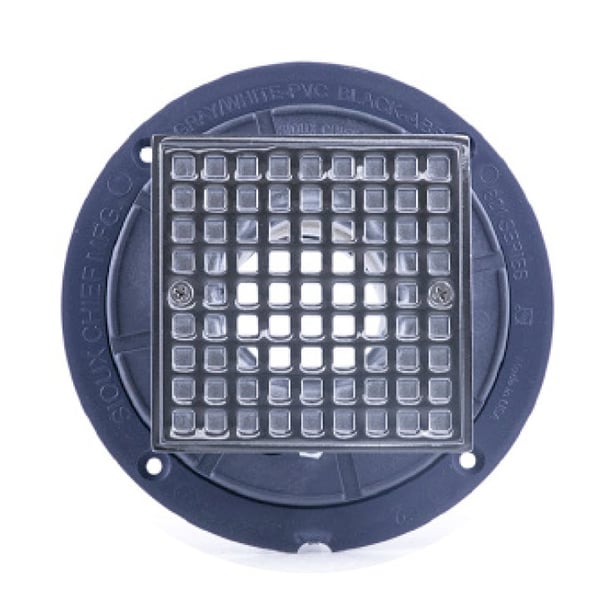 Assembled Clamping Ring courtesy of Noble Company
Three common water-management strategies
The TCNA Handbook includes several shower receptor methods. Grouping them by the relationship between the drain and waterproofing plane helps make the differences easier to see.
|
Strategy
|
TCNA methods
|
What defines the approach
|
|
Traditional water-in / water-out
|
B414, B441, B415, B420, B426, B431
|
Clamping-ring drain; waterproof pan membrane below the upper mortar bed; weep system manages incidental moisture.
|
|
Bonded membrane + clamping drain
|
B421, B421C
|
Bonded waterproofing is brought to a clamping-ring drain using the shower-drain-flashing / divot approach.
|
|
Bonded membrane + bonding-flange drain
|
B422, B422C
|
Waterproofing is bonded directly to an integrated bonding flange at the drain.
|
1 - Traditional water-in / water-out systems
In a traditional shower receptor, the waterproof pan membrane is located below the upper mortar bed. The basic sequence from bottom up is:
sloped fill -> shower pan membrane -> clamping-ring drain -> protected weeps -> mortar bed -> tile.
Water that reaches the tile surface is largely directed into the drain. Incidental moisture that passes through the grout, thinset mortar, and mortar bed reaches the sloped membrane and is directed toward the drain's weep system. That is intentional.
The fact that the upper mortar bed can receive moisture does not mean the system has failed. A properly constructed traditional receptor is designed to manage that moisture when the liner is properly sloped, the drain connection is correct, and the weep openings remain functional.
TCNA methods B414, B441, B415, B420, B426, and B431 use this basic receptor strategy. The wall and backing construction may differ, but the receptor concept remains a clamping-ring drain with the waterproofing membrane below the mortar bed.
Traditional does not mean obsolete. It means the system manages water differently.
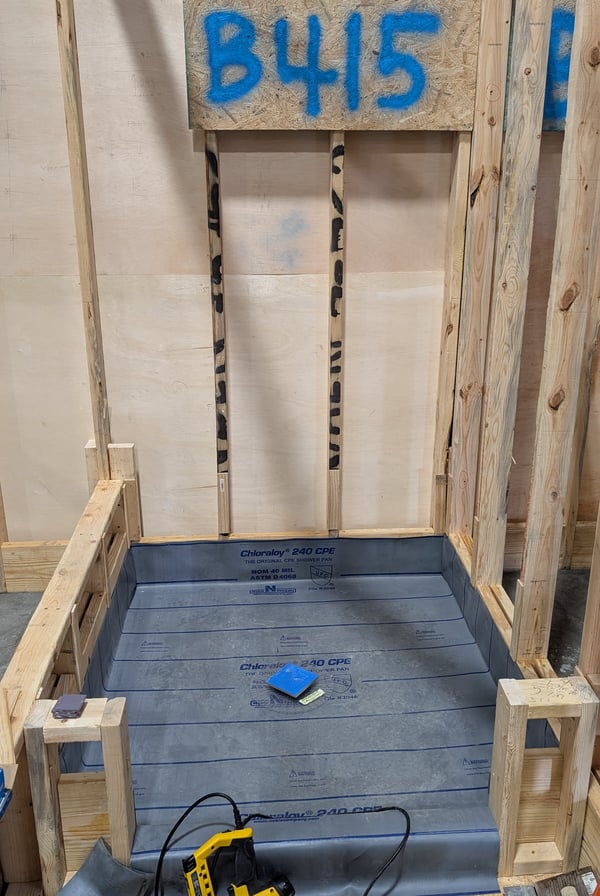 Traditional System
2 - The divot method: a clamping drain used differently
A clamping-ring drain is not limited to a traditional liner system. TCNA B421 and B421C use a clamping-ring drain with a bonded waterproof membrane and a shower drain flashing - commonly called the divot method in the field.
Here, the waterproofing strategy changes. Rather than locating the primary waterproofing below the upper mortar bed, the bonded membrane is carried over the sloped mortar base and into a recessed area around the drain, where it interfaces with the clamping-drain assembly. The recessed area is then completed in accordance with the method and membrane manufacturer requirements so drainage to the drain assembly remains functional.
This is an important example because it shows why asking only “What kind of drain do you have?” does not fully identify the system. A clamping-ring drain might be part of either a traditional pan-liner assembly or a bonded waterproofing/divot assembly. The complete method tells us how the drain is being used.
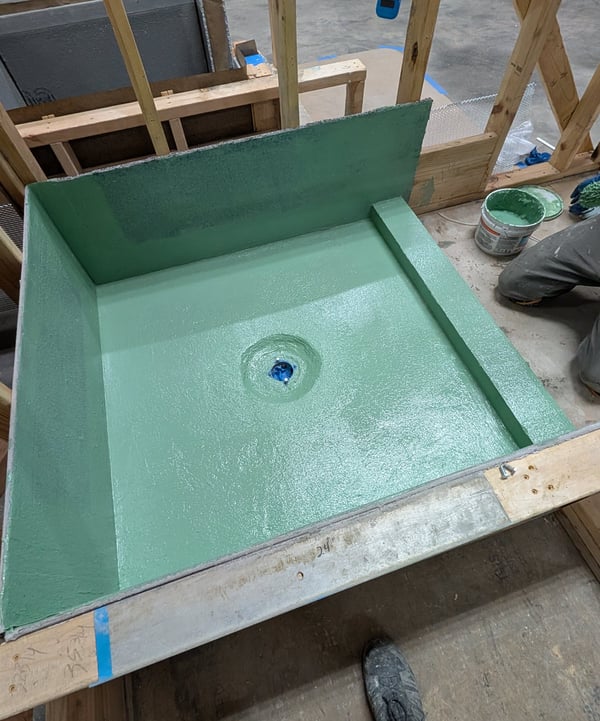
Divot Liquid Waterproofing
3 - Bonding-flange drains and surface waterproofing
TCNA B422 and B422C use an integrated bonding-flange drain with bonded waterproofing. In this approach, the primary waterproofing plane is connected directly to the drain flange and remains close to the tile installation rather than beneath an upper mortar bed.
But another misconception often enters the conversation: a bonding-flange drain does not automatically mean a foam shower pan.
Depending on the specific system, the sloped receptor beneath a surface-bonded waterproofing assembly may be created with a site-built mortar bed or with a manufacturer-approved prefabricated sloped tray. The receptor material provides slope and support; the bonded waterproofing and drain connection define the water-management strategy.
That distinction matters because “mud pan” and “foam pan” are often discussed as though they are competing waterproofing philosophies. They are not necessarily. Either can serve as the sloped base beneath a bonded waterproofing system when the complete assembly is designed and approved for that use.
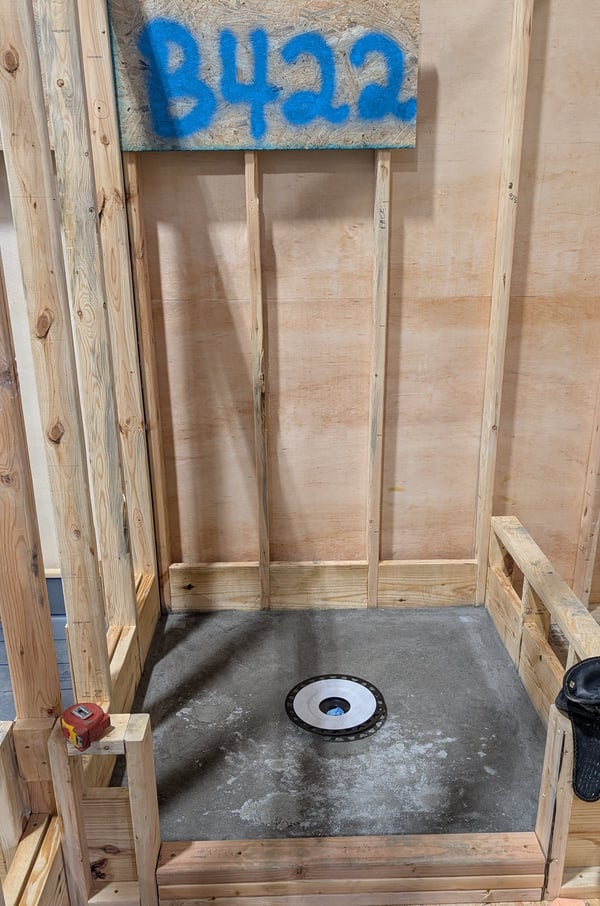
Bonding-Flange Drain
The existing drain came first. Now what?
Real projects rarely begin as cleanly as a drawing in a handbook - especially in remodeling. The plumber may already have installed a cast-iron clamping drain. The homeowner may already own a PVC liner. The specification may call for a particular drain grate. Or a bonding-flange drain may simplify the intended waterproofing, but changing the drain requires plumbing access and plumber coordination that were never discussed.
The installer still needs to stop and identify the method. The better question becomes:
Do I build an approved method around the existing drain, adapt that drain through an approved system, or have the drain changed so I can build the system specified, or as promised to the client?
What should not happen is allowing an accidental sequence of product purchases or trade decisions to invent the shower concoction rather than an approved system after the fact.
Waterproof + Waterproof does not automatically equal better waterproofing
This is another place where online advice can become confusing. Someone may successfully flood-test a sheet membrane coated with another manufacturer's liquid membrane and conclude that the combination works.
A flood test is extremely important, but it answers a limited question: did the assembly hold water during that test? It does not necessarily establish manufacturer approval, long-term compatibility, vapor behavior, drainage performance, warranty coverage, or compliance with a recognized installation method
Experienced installers often develop techniques that have worked for them for many years, and that experience has value. But repeated success with a self-developed assembly does not automatically make it an industry method.
ACT testing reinforces the same idea.
|
ADVANCED CERTIFICATIONS FOR TILE INSTALLERS (ACT) Testing
CTEF currently evaluates separate shower-receptor competencies for B415, B421, and B421C. ACT is an evaluation program, not a training program: candidates demonstrate both technical knowledge and hands-on ability in the specific installation discipline being tested.
The question is not: “Which waterproofing product do you prefer?”
It is: “Can you understand and correctly execute the method?”
|
|
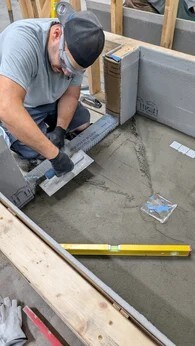
ACT B415 in progress
|
That is the mindset worth bringing to every shower project. Products change. Preferences change. The ability to recognize the assembly being built - and execute it completely - is the transferable skill.
A better decision process for shower systems
Before choosing the waterproofing product, work through the assembly in this order:
- What water-management method are we building? Traditional liner below the mortar bed? Bonded waterproofing using a clamping drain/divot? Bonded waterproofing connected to a bonding-flange drain?
- What drain does that method require? Does the existing drain work, can it be adapted through an approved assembly, or should it be replaced?
- What creates the slope? A traditional pre-slope? A site-built mortar bed? A manufacturer-approved prefabricated tray?
- Where is the primary waterproofing plane? Below the mortar bed or directly beneath the tile installation?
- Which recognized TCNA or manufacturer method describes the assembly? Identify the method before selecting individual products.
- Are all components and transitions compatible with that method? Walls, curb, niches, benches, penetrations, seams, drain connection, and movement accommodation all matter.
- How will the completed receptor be tested before tile is installed? Plan the verification step before the assembly becomes difficult to access.
Decision tree
WHAT WATER-MANAGEMENT METHOD ARE WE BUILDING?
Traditional water-in / water-out
-> clamping-ring drain -> pre-slope -> liner -> protected weeps -> mortar bed
Bonded waterproofing + retained clamping drain
-> B421/B421C-type divot approach -> surface waterproofing
Bonded waterproofing + bonding-flange drain
-> site-built mortar bed OR manufacturer-approved prefabricated tray
-> surface waterproofing integrated directly with the drain flange
|
The drain does not have to dictate the method simply because it arrived first. But once the method and drain are selected, the rest of the assembly must be compatible with both.
Methods before materials
Tile installers have more excellent shower products available today than ever before.
- Traditional liners remain viable.
- Bonded sheet and liquid membranes offer different approaches.
- Mortar beds provide tremendous flexibility.
- Prefabricated trays can improve efficiency.
- Clamping drains, bonding-flange drains, and approved adapters each have a place.
The trouble begins when products are selected independently and expected to become a system after the fact. Choose the method. Select or change the drain to support it. Build the correct slope. Locate the waterproofing where the method requires it. Then use compatible materials to complete the assembly.
Method first. Materials second. Execution always, for a successful shower system.
As you've discovered from this article, you'll want to determine which shower system you are actually building so you can properly identify the method to follow for a successful shower installation. Method first; materials second!
If you would like to dive deeper into the evolution of the shower receptor, methods, and materials, sign up for the next Comprehensive Shower Class.
Thanks for reading.
>> Download the CTI Information Kit <<
Technical References
>> 2026 TCNA Handbook for Ceramic, Glass, and Stone Tile Installation
>> Tile Council of North America, Showers FAQs
>> CTEF Advanced Certifications for Tile Installers (ACT)
>> CTEF Listing of ACT Certified Installers
###
About “From the Feed”
Every day, installers, contractors, homeowners, manufacturers, and inspectors trade advice online about tile installation. Some of that advice is excellent. Some is incomplete. And sometimes, several people are giving different answers because they are actually describing different methods. From the Feed takes common online questions and brings them back to recognized methods, applicable standards, manufacturer requirements, and sound installation practice.
The goal is not to decide who won an online argument. It is to ask a better question: What does the industry guidance actually require, and how should we apply it in the field?