

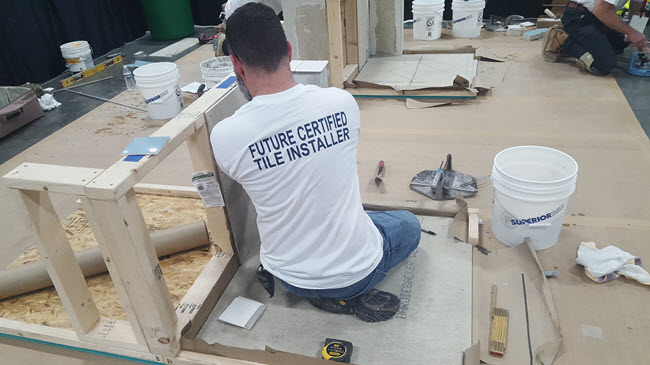
You've been in the tile trade long enough to know that two installers can look at the same finished floor and walk away with completely different opinions about its quality. One sees acceptable workmanship. The other spots three problems before crossing the threshold. This disagreement isn't about stubbornness—it reflects a real challenge in our industry: objectively assessing tile installation skills in field conditions is genuinely difficult.
CTEF addresses this challenge head-on through the Certified Tile Installer (CTI) program, which establishes measurable standards for evaluating installer proficiency. Understanding why skill assessment is so difficult in the first place helps you appreciate the value of third-party certification and what it takes to truly demonstrate your expertise.
Key Takeaways: What Makes Tile Skills Hard to Assess Objectively
- Field evaluation of tile skills often relies on subjective visual judgment, which varies from observer to observer and lacks standardization.
- Job site variables like lighting, substrate conditions, and time pressure make consistent assessment nearly impossible without controlled testing environments.
- Observable workmanship tells only part of the story—mortar coverage and transfer to the back of the tile, along with proper membrane installation, remain hidden beneath the finished surface.
- Industry standards from ANSI and the methods and details from the TCNA Handbook define specific tolerances, but applying them consistently requires trained evaluators with calibrated assessment methods.
- CTEF's Certified Tile Installer (CTI) program uses third-party evaluators and standardized testing to remove bias from skill assessment and verify qualified labor.
Why Visual Inspection Alone Falls Short for Evaluating Tile Skills
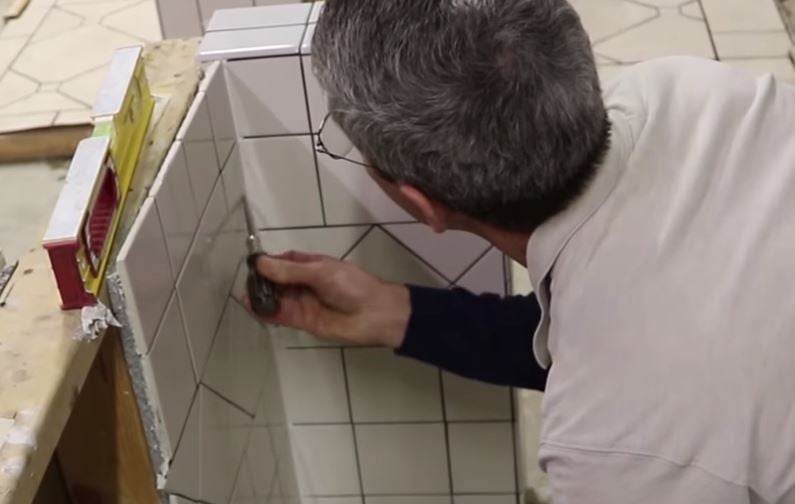
When you walk onto a job site to assess an installer's work, what do you actually see? Finished tile, grout joints, and whatever conditions the installation environment presents at that moment. You can spot obvious problems like cracked tiles or uneven grout, but visual inspection has serious limitations.
>> See How to Evaluate a Finished Tile Installation
The quality of permanent lighting is more important than most people realize. A grout joint that looks uniform under a jobsite lightbulb may reveal inconsistencies in natural daylight. The angle of observation changes what defects become visible. Two experienced professionals can examine the same installation from different positions and identify completely different concerns.
According to TileLetter, inspectors recognize that workmanship quality "will always show itself front and center whether it's good or bad." But the challenge is that every observer brings different expectations, experiences, and biases to that assessment.
How Hidden Work Complicates Accurate Skill Assessment
The most critical aspects of tile installation happen before you can see the finished surface. Mortar coverage and transfer to the back of the tile, membrane application, substrate preparation, and movement joint installation all occur behind the tile. By the time you're evaluating the installation, these elements are completely concealed.
Industry standards set clear requirements for mortar coverage—80% minimum in dry areas, 95% in wet areas. But without removing tile or using specialized detection methods, you have no way to verify whether an installer achieved proper mortar coverage and transfer to the back of the tile. You're left assessing appearance while the structural integrity of the installation remains a mystery.
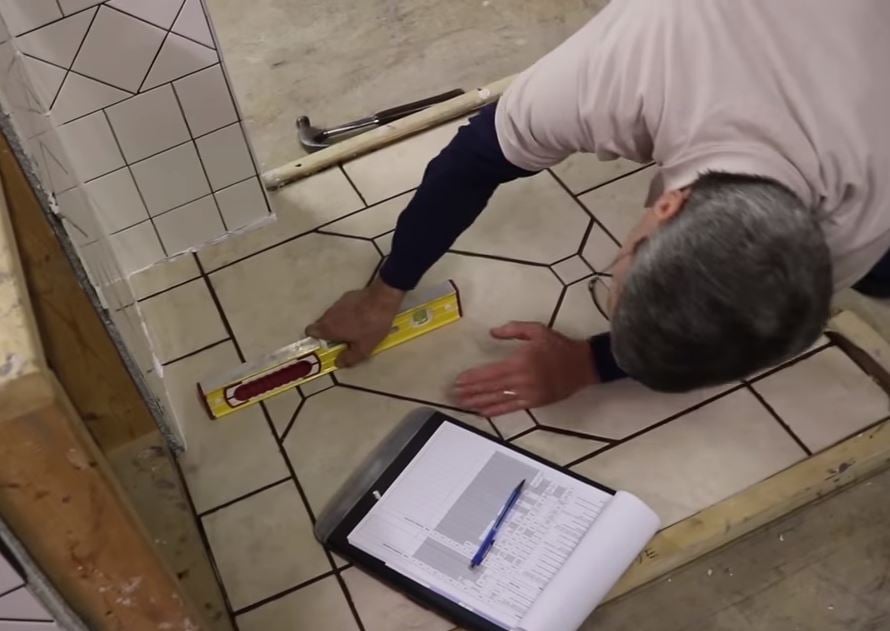
This is exactly why third-party certification programs require hands-on testing where evaluators can directly observe installation techniques and remove tile to verify coverage and transfer after completion. CTEF evaluators photograph every stage of the assessment, documenting both the visible workmanship and what lies beneath the surface.
>> See Grading the Toughest 25 Square Feet of Tile You'll Ever Install (Video)
What Role Do Job Site Variables Play in Assessment Inconsistency?
Field conditions introduce countless variables that make standardized evaluation nearly impossible. Consider the differences between assessing tile work in a temperature-controlled showroom versus a construction site with fluctuating humidity, dust, and limited lighting.
Time pressure affects installer performance in ways that are hard to quantify. An installer racing to meet a deadline may make different choices than one working without schedule constraints. Does that rushed work reflect their true skill level, or just the conditions they faced that day?
Substrate conditions vary dramatically from job to job. Evaluating an installer's skill based on work done over poorly prepared concrete versus work done on a flat and properly finished concrete floor doesn't give you an accurate comparison of abilities. The substrate itself becomes a confounding variable in any assessment.

How Standards Create a Framework for Objective Evaluation
ANSI standards and the TCNA Handbook establish specific, measurable criteria for tile installation quality. Lippage tolerances, flatness requirements, coverage percentages—these numbers give evaluators something concrete to measure against rather than relying on personal judgment.
The ANSI standard for substrate surfaces (A108.02, section 4.2.2) states that for tiles with at least one edge 15 inches or longer, the maximum allowable variation is 1/8 inch in 10 feet. This isn't opinion—it's a measurable specification that any trained evaluator can verify with the proper tools.
But having standards isn't the same as applying them consistently. Without trained evaluators using calibrated equipment and standardized procedures, two assessors might interpret the same measurement differently. The standards exist. The challenge is implementing them uniformly across every evaluation.

Why Third-Party Assessment Removes Bias from Skill Evaluation
When a contractor evaluates their own crew, bias is inevitable. You've invested in these installers, trained them, and need them on upcoming jobs. Seeing their work objectively becomes difficult when so many other factors influence your perception.
Similarly, when a general contractor assesses a tile sub's work, schedule and budget pressures can color that evaluation. The desire to keep the project moving may lead to accepting work that an impartial evaluator would flag as below standard.
Third-party evaluation eliminates these conflicts of interest. The Certified Tile Installer program from CTEF uses independent evaluators who have no stake in whether a candidate passes or is not successful. Their only concern is accurate, consistent application of industry standards.
What Does Controlled Testing Reveal That Field Assessment Cannot?
The CTI hands-on test creates conditions where every installer faces identical challenges. Same substrate. Same tile. Same time constraints. Same evaluation criteria. This controlled environment isolates actual skill from the random variables that affect every field installation.
Evaluators can observe techniques in real time rather than guessing at methods based on finished results. Did the installer use proper trowel techniques for keying in the mortar and straight-line mortar application? Did they move the tile in a back-and-forth motion as seen in the Trowel and Error video? These process elements determine long-term installation success but remain invisible in a finished installation.
>> See How to Correctly Trowel Mortar When Installing Tile?
The testing process also requires installers to remove tile so evaluators can verify mortar coverage/transfer and inspect critical details like backer rod placement in movement joints. As one industry professional noted, the CTI test is often called "the toughest 25 square feet you'll ever install" because it compresses so many evaluation criteria into a manageable testing space.
How Evaluator Training Ensures Consistent Assessment Results
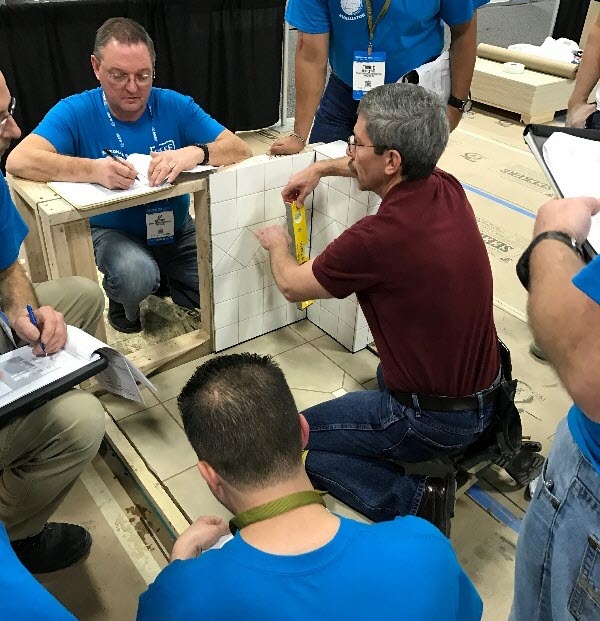
Using the standards means nothing if evaluators apply them differently. CTEF addresses this through rigorous evaluator training that calibrates assessors to score installations identically, regardless of who performs the evaluation.
The Evaluator Boot Camp requires candidates to thoroughly review each aspect of the CTI test before they can evaluate others. This firsthand experience ensures evaluators understand exactly what they're assessing and the challenges installers face. Many evaluators describe gaining "newfound respect" for the difficulty of the test after completing the Boot Camp.
Evaluators learn that scoring must be "accurate and precise...in order to keep the test fair to all participants." Industry evaluators from manufacturers have noted that the scoring system is "very clear, and not subjective to the evaluator's opinion or viewpoint." This consistency protects the integrity of the certification.

What Does Certification Prove That Years of Experience Cannot?
Experience measures time spent on the job. Certification measures demonstrated competency against specific standards. An installer with 20 years in the trade has certainly developed skills, but without objective testing, you're trusting that their habits align with current industry standards and best practices.
Materials and methods evolve constantly. Large format tile, gauged porcelain panels, new membrane systems—the tile industry today looks different than it did a decade ago. Certification confirms that an installer's knowledge and techniques meet current requirements, not just the standards that existed when they learned the trade.
The TCNA Handbook defines qualified labor as installers who have "demonstrated their commitment to their craft and taken the time to stay current with the latest materials and methods." Certification through programs like the CTI or the Advanced Certifications for Tile Installers (ACT) verifies this commitment through actual testing.
In Conclusion: Building a Better System for Tile Skill Assessment
The difficulty of objectively assessing tile skills in field conditions isn't a flaw in our industry—it's a reality we must acknowledge and address. Visual inspection, personal judgment, and informal evaluation will always have limitations. Job site variables, hidden work, and human bias make consistent field assessment nearly impossible.
Standards-based certification through programs like CTEF's Certified Tile Installer program offers a solution. By combining clear industry standards, controlled testing environments, trained third-party evaluators, and verification of both visible and hidden workmanship, certification creates the objective measurement that field assessment cannot achieve.
Do your customers and yourself a favor—pursue certification that validates your skills through a system designed for objectivity.

FAQs About What Makes Tile Skills Hard to Assess Objectively
Why is it difficult to evaluate tile installation skills objectively in the field?
Field conditions introduce variables like lighting, substrate quality, and time pressure that make consistent evaluation nearly impossible. Additionally, critical work like mortar coverage and membrane installation remains hidden beneath the finished surface, preventing accurate assessment of installation quality.
How does CTEF address the challenge of subjective tile skill assessment?
CTEF's Certified Tile Installer program uses standardized hands-on testing, trained third-party evaluators, and controlled conditions to remove bias from skill assessment. Evaluators verify both visible workmanship and hidden elements like mortar coverage by removing tile during the evaluation process.
What industry standards define tile installation quality?
ANSI standards and the TCNA Handbook establish specific tolerances for flatness, lippage, mortar coverage, and other quality metrics. These measurable specifications give evaluators concrete criteria to assess rather than relying on subjective judgment about acceptable workmanship.
Can visual inspection alone determine tile installer skill level?
Visual inspection has significant limitations. It cannot reveal mortar coverage and transfer beneath tiles, membrane integrity, or proper movement joint preparation. CTEF certification addresses this gap by requiring evaluators to observe installation techniques and verify hidden work during hands-on testing.
Why does third-party certification matter for tile installers?
Third-party certification from organizations like CTEF eliminates bias that occurs when contractors evaluate their own crews or when project pressures influence assessments. Independent evaluators focus solely on accurate, consistent application of industry standards, verifying true installer competency.
How does experience differ from certification in tile installation?
Experience measures time in the trade, while certification measures demonstrated competency against current industry standards. CTEF certification confirms that an installer's knowledge and techniques meet today's requirements, including proper methods for large format tile, membranes, and other evolving materials.